
Munich
Discover
Munich
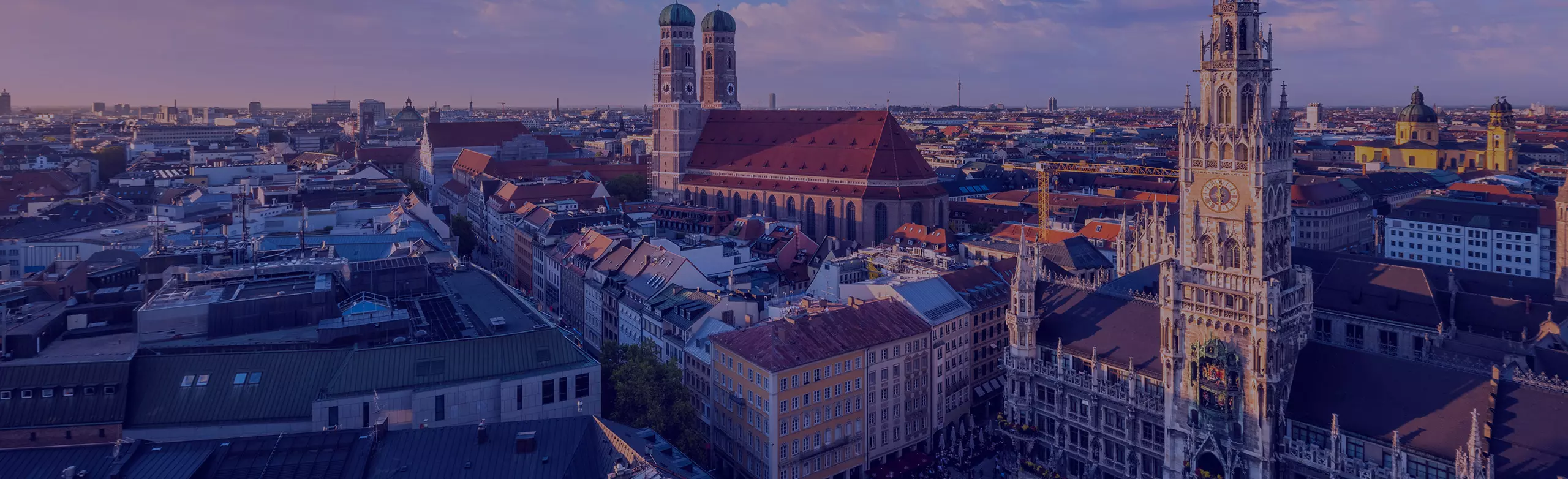
Munich is the third largest city in Germany and is located in the south of the country, in the federal state of Bavaria, of which it is the capital and largest city. Munich has a population of around 1.5 million inhabitants, while about 6 million people live in the metropolitan area. The city covers an area of 310 square kilometers ( 120 sq/mi)and lies on the Isar River. Munich was first mentioned in 1158, and the Residenz, later the residence of Bavarian rulers, began to be built in 1358. In 1806, Munich became the capital of the Kingdom of Bavaria. The historic center features Marienplatz with the New Town Hall, the Frauenkirche Cathedral, and the Residenz, one of the largest city palaces in Europe. Munich is also an important shopping destination, with luxury boutiques and department stores along Maximilianstraße, Kaufingerstraße, and around Marienplatz, as well as traditional markets such as Viktualienmarkt. Local cuisine reflects Bavarian traditions and includes dishes like Weißwurst, Schweinshaxe, pretzels, and sausages, best enjoyed with famous Bavarian beer. Munich and the whole of Bavaria are world-renowned for beer culture, highlighted by Oktoberfest, held annually since 1810.




Nuremberg
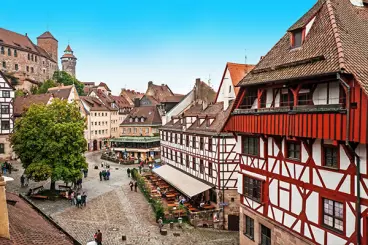
Nuremberg is a historic city in Bavaria with a population of about 520,000 inhabitants. In the Middle Ages, Nuremberg was one of the most important cities of the Holy Roman Empire and a major center of trade and craftsmanship. The city is famous for its well-preserved medieval Old Town, dominated by Nuremberg Castle, St. Lawrence Church, and the Main Market Square. Local cuisine is renowned for Nürnberger Rostbratwürste, gingerbread known as Lebkuchen, and traditional Franconian beers. https:/mus.nuernberg.de/en//touris
Car: 170 km (106 mi)
Train: 1:10 hour
Bus: 2:00 - 2:20 hours
Regensburg
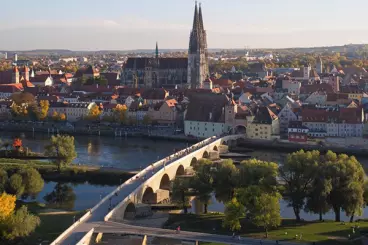
Regensburg lies east of Munich on the Danube River and is one of the best-preserved medieval cities in Germany. Its historic Old Town, with narrow streets, patrician houses, the Gothic St. Peter’s Cathedral, and the Danube riverbanks, is listed as a UNESCO World Heritage Site. A major landmark is the Stone Bridge, built between 1135 and 1146, which is the oldest surviving stone bridge in Germany. In the Middle Ages, Regensburg was an important trading center and today it attracts visitors with its rich history and lively atmosphere. https://tourismus.regensburg.de/en/
Car: 125 km (78 mi)
Train: 1:30 - 2:00 hours
Bus: 1:40 - 2:00 hours
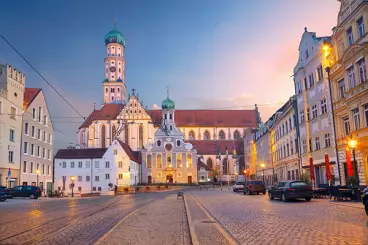
Augsburg
Augsburg is the historic capital of the Swabia region and, with around 300,000 inhabitants, the third largest city in Bavaria. Founded by the Romans, Augsburg is one of Germany’s oldest cities and features a well-preserved medieval historic center. The city is especially famous for its unique Water Management System, developed from the 14th century onwards, which includes canals, water towers, and fountains and is listed as a UNESCO World Heritage Site. Augsburg was also a major center of trade and banking during the Renaissance, closely linked to the powerful Fugger family, and today it combines rich history with a vibrant urban life. https://www.augsburg-tourismus.de/en/welcome
Car: 70 km (44 mi)
Train: 30 mins
Bus: 1 hour