
Chengdu
Discover
Chengdu
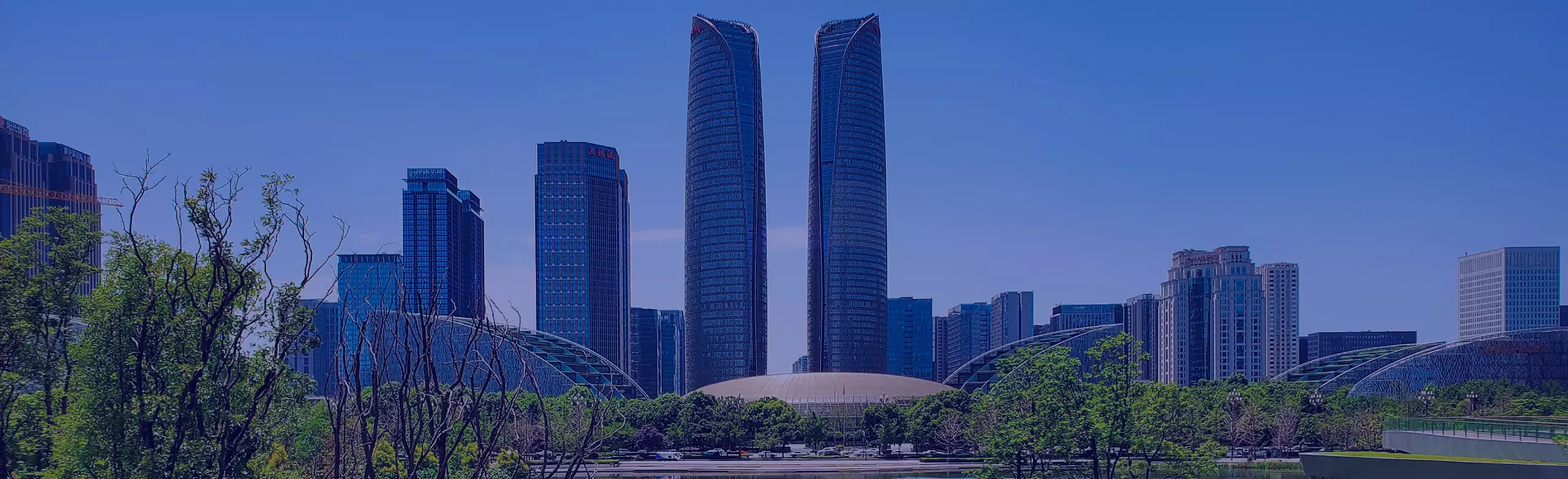
Chengdu is the capital of Sichuan in southwestern China and one of the country’s largest and most dynamic cities. It has a population of more than 21 million people and covers an area of approximately 14,300 sq km (5,521 sq mi). The city lies in the fertile Sichuan Basin, surrounded by mountains and crossed by several rivers, which have supported agriculture and settlement for thousands of years. Chengdu has a history stretching back more than 2,300 years and is closely associated with the ancient Dujiangyan Irrigation System, completed in 256 BC and still in use today. Another important landmark is the historic Wenshu Monastery, rebuilt in 1691 during the Qing Dynasty. Modern Chengdu is known for impressive skyscrapers such as Chengdu IFS Tower 1 and Tianfu International Finance Center. Chunxi Road is the city’s best-known shopping street, while Tianfu Avenue is one of China’s longest urban boulevards. Chengdu is world-famous as a center for the conservation of the Giant Panda. The city is also renowned for its spicy Sichuan cuisine, especially hot pot, mapo tofu, kung pao chicken, and dan dan noodles, making it one of China’s great culinary destinations.




Luodai Ancient Town
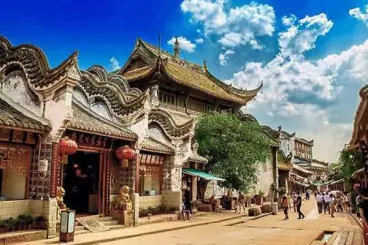
Luodai Ancient Town is a historic town located east of Chengdu. Its history dates back more than 1,800 years to the period of the Three Kingdoms. The settlement developed during the Song Dynasty and expanded significantly in 1717, when large numbers of Hakka people settled in the area during the Qing Dynasty. Luodai is renowned for its well-preserved Hakka architecture, featuring ancestral halls, traditional courtyard houses, and narrow stone-paved streets. A unique aspect of the town is that it preserves one of the largest Hakka communities in western China, earning it the nickname “The Hakka Ancient Town of Chengdu. https://www.sichuantravelguide.com/chengdu/attractions/luodai-anicent-town.html
Car: 29 km ( 18 mi), 40 - 50 mins
Metro + Bus: 1 hour ( Metro Line 2 transfer Long Quandong Railway Station)
Dujiangyan Irrigation System
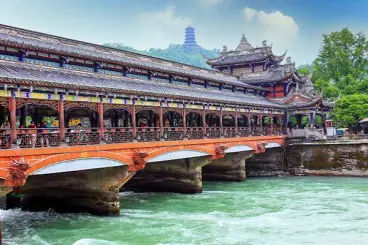
The Dujiangyan Irrigation System is an ancient water management system located near Chengdu. It was designed in 256 BC by the engineer Li Bing and his son during the Qin Dynasty. Instead of using a dam, the system diverts the waters of the Min River through channels and levees, reducing floods and irrigating more than 5,300 square kilometres (2,050 square miles) of farmland. The main channel network extends for over 50 kilometres (31 miles). Its unique design has functioned continuously for more than 2,200 years. Visitors should begin at the Yuzui (Fish Mouth Levee), the heart of the entire engineering system. An ideal place to begin your visit is the city of Dujiangyan. https://intotravelchina.com/attractions/chengdu_attraction/dujiangyan_irrigation_system.html
Car: 60 km ( 37,5 mi), 45 mins -1 hour
Train: 20 - 25 mins (Dujiangyan Railway Station)
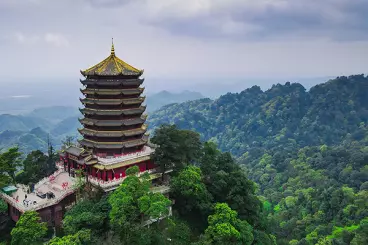
Mount Qingcheng
Mount Qingcheng is one of China’s most famous sacred mountains and is considered one of the birthplaces of Taoism. Located near Chengdu, the mountain is renowned for its lush forests, misty peaks, and peaceful atmosphere. Its highest point, Laoxiao Peak, rises to 1,260 metres (4,134 feet) above sea level. Ancient Taoist temples hidden among the trees create a landscape often described as “the greenest mountain under heaven.” A unique feature of Mount Qingcheng is its combination of natural beauty and spiritual heritage, which earned it UNESCO World Heritage status.From Qingchengshan Railway Station, it is about 2 kilometres (1.2 miles) to the main entrance, which can be reached in 5–10 minutes by taxi or 20–30 minutes on foot. https://www.sichuantravelguide.com/qingchengshan/
Car: 60 km ( 37,5 mi), 45 mins
Train: 25 - 35 mins